Gravity Without Force: The Quiet Power Behind Truly Magnetic Companionship
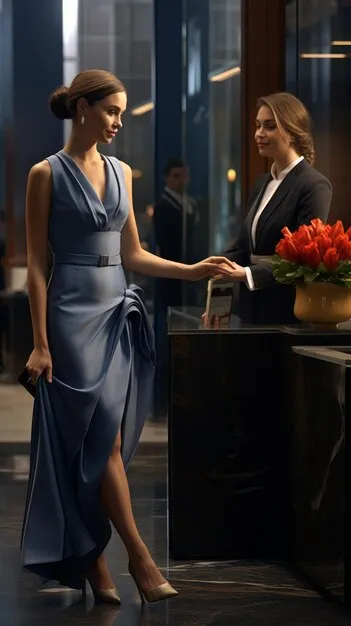
Photo: elegant woman confident presence luxury hotel lobby evening attire, via img.freepik.com
There is a particular kind of person who, upon entering a room, does not announce themselves. They do not perform an entrance. They simply arrive — and somehow, almost imperceptibly, the atmosphere shifts. Conversations become more deliberate. Postures straighten. Attention, which moments before was scattered across a dozen distractions, begins to consolidate around a single point. This is presence. And in the world of elite companionship, it is the single most valuable quality a professional can possess.
It is also, notably, the quality most difficult to feign.
The Distinction That Separates the Memorable from the Merely Pleasant
Clients who have experienced companionship at a genuinely elevated level often struggle to articulate precisely what made the encounter exceptional. They will reach for words like "comfortable" or "natural," and occasionally land on something closer to the truth: seen. They felt, for the duration of that evening or engagement, genuinely and specifically seen — not as a category of person, not as a transaction, but as an individual with a particular history, a particular set of preoccupations, and a particular need for connection that evening.
This is the fundamental distinction between performative charm and authentic engagement. Performative charm is a skill set. It can be learned, rehearsed, and deployed with reasonable consistency. It involves mirroring body language, deploying well-timed humor, and maintaining eye contact at statistically optimal intervals. These techniques are not without value — they form the baseline competency of any professional in the hospitality or service industries.
Authentic engagement, however, operates at an entirely different register. It requires a genuine orientation toward the other person: a real curiosity about who they are, a willingness to be affected by what they share, and an attentiveness that does not require conscious effort because it is not being performed. It simply is.
Elite companions at the highest tier of the industry have, whether through temperament or deliberate cultivation, developed this orientation as a default mode of operating.
Strategic Vulnerability as a Tool of Connection
One of the more counterintuitive aspects of commanding presence is the role that vulnerability plays in it. There is a cultural assumption — particularly prevalent in American professional contexts — that authority and openness exist in tension with one another. To be powerful is to be guarded. To be composed is to be closed.
The most sophisticated companions have largely abandoned this assumption. They understand that selective, well-calibrated vulnerability is not a weakness to be minimized but a bridge to be extended. When a companion shares a genuine reaction — a real laugh, an honest admission of unfamiliarity with a topic, a moment of authentic curiosity — it creates an asymmetry of intimacy that draws the client toward them rather than pushing them away.
The operative word, of course, is calibrated. There is a meaningful difference between strategic openness and indiscriminate disclosure. The former is offered with intention, in response to the specific texture of a given interaction. The latter is simply a lack of professional discretion. Elite companions navigate this distinction with considerable fluency, knowing precisely how much of themselves to reveal and at precisely which moments that revelation will deepen rather than destabilize the connection.
The Psychology of Feeling Uniquely Valued
Research in social psychology has long established that human beings have a fundamental need not merely to feel liked, but to feel specifically liked — appreciated for the particular qualities that distinguish them from others rather than for the generic qualities they share with everyone. This distinction carries enormous weight in the context of luxury companionship.
A client who has achieved a significant degree of professional or financial success has, in all likelihood, grown accustomed to a certain quality of social attention. They have been flattered. They have been deferred to. They have been treated with the careful courtesy that accompanies wealth or status in most social environments. What they have often experienced less frequently is genuine curiosity — someone who is interested not in what they represent but in who they actually are.
Elite companions create this experience through a practice that might be described as active specificity: the habit of noticing and reflecting back the details that individuate a person. Not the broad strokes of their biography, but the small particulars — the way they describe a problem, the specific quality of enthusiasm they bring to a subject they care about, the things they almost say before redirecting themselves. Attending to these details and responding to them directly communicates, without a word of explicit affirmation, that this person is being genuinely witnessed.
The effect is, for many clients, quietly profound. It is one of the primary reasons that relationships with elite companions often develop a depth and durability that purely transactional interactions rarely achieve.
Presence as Discipline, Not Performance
It would be a mistake to conclude from the above that presence is entirely effortless — that it simply flows from natural temperament without any cultivated discipline underlying it. The companions who maintain this quality consistently, across varied clients and contexts and emotional states, have typically developed a set of practices that support it.
These practices vary considerably from individual to individual, but common threads emerge: a genuine investment in continued learning across a wide range of subjects, so that intellectual curiosity is never feigned; deliberate attention to physical and emotional self-regulation, so that the companion arrives to each engagement genuinely available rather than depleted; and a cultivated capacity for what might be called selective forgetting — the ability to set aside the residue of previous interactions and encounter each new client with fresh attention.
This last quality deserves particular emphasis. One of the subtle failures of less experienced or less disciplined companions is the tendency to allow previous interactions to color present ones — to bring expectations, assumptions, or emotional carryover from one engagement into the next. The most accomplished professionals treat each encounter as its own complete world, with its own logic, its own emotional weather, and its own particular demands on their attention.
Why Luxury Clients Recognize the Difference
Clients who seek companionship at the elite level are, almost by definition, individuals with sophisticated social intelligence. They have navigated complex professional environments, managed significant relationships, and developed — often without fully theorizing it — a finely calibrated sense for the difference between authentic engagement and its simulation.
They know, in other words, when they are being worked. And they know, with equal clarity, when they are not.
This is precisely why presence — genuine, unforced, disciplined presence — is not merely a desirable quality in elite companionship. It is the foundational currency upon which everything else is built. Conversation, discretion, aesthetic refinement, intellectual compatibility: all of these qualities matter. But they matter most when they are delivered by someone who is actually, fully, and without reservation there.
Gravity, after all, does not announce itself. It simply holds.